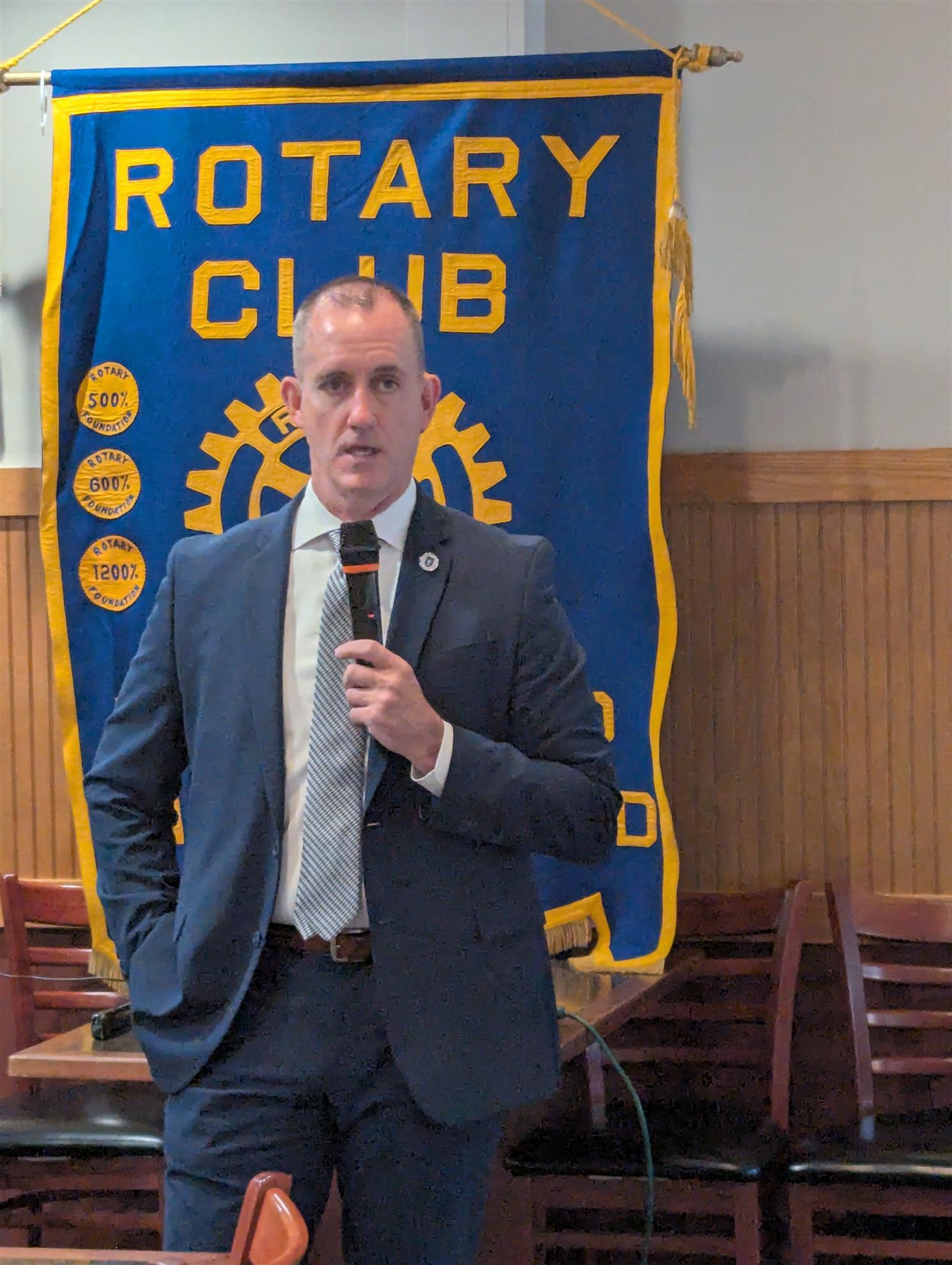
Our guest speaker today was South Kingstown Police Chief and Wakefield Rotarian Matthew Moynihan. Matt gave us a highly informative and relevant overview of the recent controversies surrounding Flock cameras and how law enforcement responds to and manages an active shooter situation.
Police Chief Matt began with a review of a recent active shooter (SWAT) threat that occurred at South County Hospital. After a call was placed to the hospital switchboard claiming that the caller was in the vicinity with a long rifle and threatened to kill people, she immediately notified SK police and kept the caller engaged so as to allow the call to be traced. SK police responded on the scene within minutes and together with hospital officials, instituted a “lock down” of the facility. He explained that this, along with other timely decisions that have to be made, can have mixed results. For instance, while a lock down can protect people from straying outside the building and being shot at, there is the risk that people can be harmed if there happens to be an explosive device inside the building. As the situation evolves, there are many other decisions, including when to call an “all clear” that require careful but immediate action so as to avoid (or at least minimize) loss of life.
An active shooter also generates an immediate response from neighboring and state police departments along with EMS to respond and in this recent episode a total of 78 police officers responded! As Matt pointed out, this mass deployment can be a mixed blessing in that it can leave our community exposed to other threats. One of the greatest challenges continues to be the effect that postings on social media has on both enhancing but also distorting events as they unfold. He also pointed out that social media is a valuable tool that active shooters rely on to instill fear and gain recognition.
Matt then turned to “Flock cameras” which actually refers to a brand name of automated license plate recognition (ALPR) cameras that are manufactured by several companies. The Flock brand manufactures and operates surveillance hardware and software and they happen to dominate the supply of ALPRs across the U.S. This comes with a mixed blessing because their name has become synonymous with all ALPRs and the controversy/negative publicity associated with this technology. The controversy revolves around the concern that this constitutes a form of mass surveillance and their effects on privacy and other civil liberties. The concern about government overreach, especially in our current politically charged time, and the inappropriate use of data to track people's movements are at the heart of the controversy.
Matt went on to explain that, like any new technology, there are benefits and risks. We live in a world where our movements are tracked in many other ways, through our cellphones and other kinds of surveillance cameras that private and municipal agencies use. He explained that the misuse of this technology lies not in the device but the potential misuse by the agencies using the device. This comes down to a matter of regulation, placed by the agencies (mostly police departments), on the proper conditions with which the data is accessed and used. As Chief of police in SK and with 30 years of experience in several aspects of law enforcement, Matt has developed a set of regulations which have become the model for the state of RI. His policy specifically restricts the use of this data only for criminal investigations and he holds his subordinates to that standard. He believes that when all municipalities adopt and enforce this standard much of the controversy will go away.
Chief Matt's presentation went well beyond his allotted time as his captive audience asked many great questions abut both topics.